Before & After: Photographing a Fear-Reactive Rescue Dog
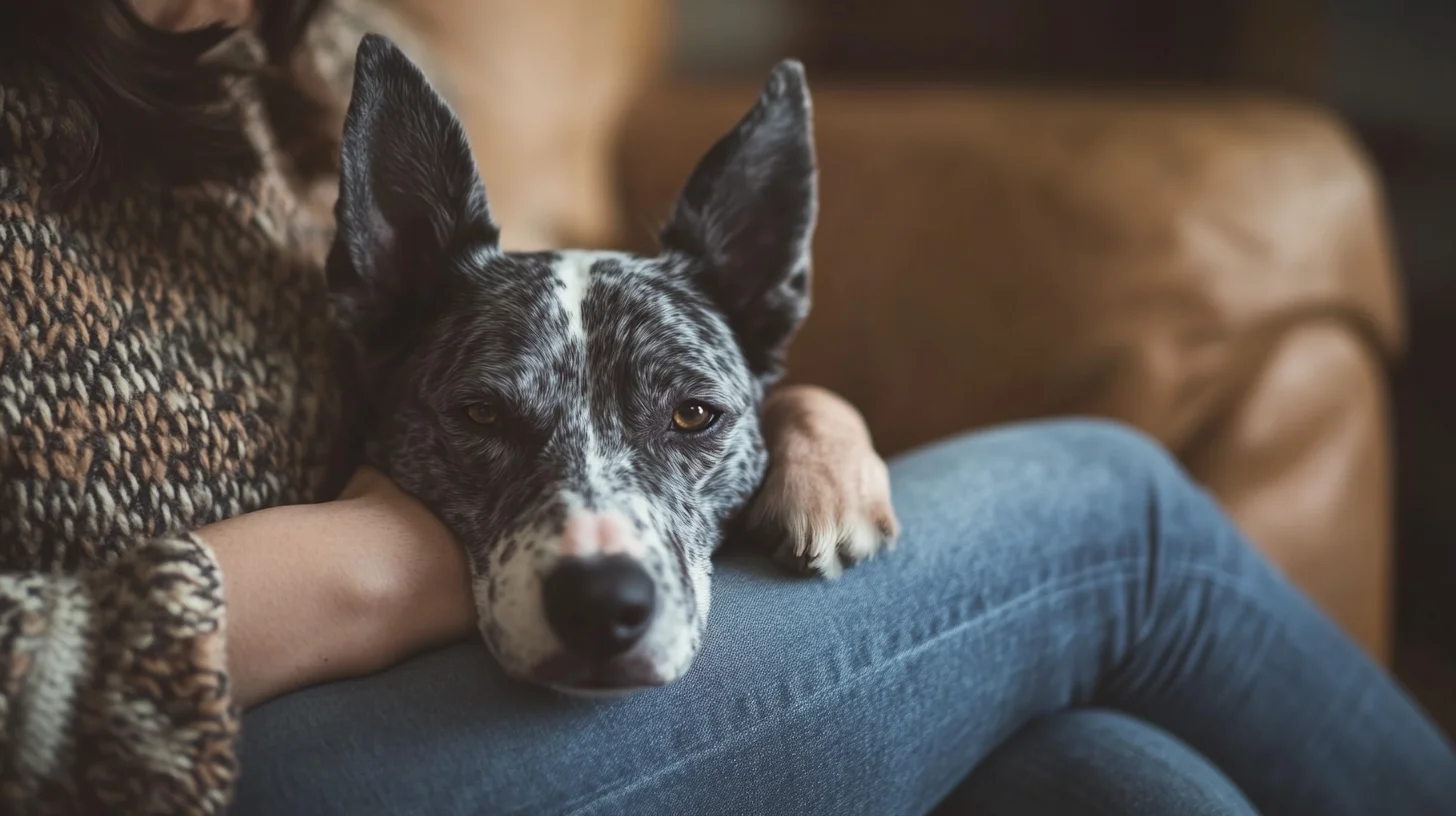
This case study describes a real session and a real dog. The dog's name, breed details, and adopter's name have been changed at the family's request. The process, timeline, and outcomes are exactly as they happened.
I'm calling her Maeve. She's a four-year-old cattle dog mix — adopted roughly seven months before the session from a Texas rescue that pulled her from a rural shelter in Louisiana. She came north with what her adopter later described as “a suitcase of trauma,” and by the time I met her she had already been through four months of behavioral training, two medication trials, and a completely restructured household routine. Her adopter wanted a single good portrait of her — just one — to mark how far they'd come. This is the story of that session, start to finish.
The First Email
The initial contact form was the longest I'd received in months. Three paragraphs. The adopter — I'll call her Sarah — described a dog who had never been photographed because every attempt had gone badly. Phone cameras triggered a lunge-and-bark response. A previous photographer had given up at the twenty-minute mark. Maeve had spent the first four months in the new home hiding in a closet for ten hours a day. Progress since had been slow and real.
What Sarah wanted was simple: one good portrait of the dog she actually lived with now. Not the terrified dog who came off the transport truck. The current dog — the one who had started playing with a ball in the backyard, who had learned to come to her when called, who had begun to sleep in the bedroom instead of the closet.
“I don't need fifty portraits,” she wrote. “I need one. I need to see her looking like herself in a photograph so I can prove to myself that the progress is real.”
The Pre-Session Call
We talked for forty-five minutes. Longer than usual. Sarah had a lot of context and I had a lot of questions. What I learned: Maeve's baseline fear response was flight, not aggression. When she couldn't flee, she froze. The bark-and-lunge that had happened with phone cameras wasn't predation; it was a desperation behavior, her last option when she couldn't escape and couldn't hide.
She was working with a certified behaviorist. She was on Prozac, which had been stable for three months. She had two trigger categories: unfamiliar men and unfamiliar objects pointed in her direction. I am an unfamiliar man, and a camera lens is an unfamiliar object pointed in her direction. This was the problem.
We designed the session together. An in-home session. I would arrive without a camera bag. I would sit in the kitchen for the first thirty minutes with a coffee and talk to Sarah about everything except the dog. The camera would come out of a tote bag on the floor, not a professional bag slung over a shoulder. The first frames would be of objects — a vase, the kitchen counter, a dog toy — not the dog. I would shoot from my knees or the floor, never standing and pointing down.
Sarah would keep Maeve on a leash in a soft body harness throughout, even in the house. Not because Maeve was a flight risk inside — but because the routine of being on leash was already associated with calm, predictable behavior for her. Familiar equipment in a familiar space.
The First Hour
I arrived at 10 a.m. on a Tuesday. Sarah met me at the door. Maeve was behind a baby gate at the far end of the living room, watching, still. I walked past the gate without looking at her and sat down in the kitchen. Sarah had a mug of coffee waiting for me. We talked about her job, about Maeve's training progress, about the Cape house the family was renting later that summer. Forty minutes passed.
Around minute forty, Maeve's body language changed. The tension in her shoulders dropped. She lay down behind the gate. She closed her eyes for about ninety seconds, opened them, scanned me once, and closed them again. Sarah and I kept talking. I didn't look at the dog.
At minute fifty-five, Sarah opened the baby gate. Maeve didn't move at first. Then she stood up, took three careful steps into the kitchen, sniffed the corner of my backpack, and retreated to the doorway. I still didn't look at her. Sarah handed me a piece of cheese and told me to drop it on the floor near my foot. Maeve came, ate the cheese, and sat on her bed about eight feet away.
At minute sixty-five, I pulled the camera out of the tote bag and set it on the table. It just sat there for ten minutes. Maeve watched it once, then ignored it.
The First Frame
At minute seventy-five, I made my first photograph — of a bowl of lemons on the counter. The shutter clicked. Maeve's ears moved. Nothing else. I made three more photographs — a dog toy, the patch of sunlight on the floor, Sarah's hands around her coffee cup. Maeve watched each one with interest. She was learning what the sound and the object did.
At minute eighty-five I made my first photograph of Maeve herself. She was lying on her bed, looking at Sarah, not at me. The camera was at my knee, pointed about thirty degrees off from her direct line. The shutter clicked and she looked toward the sound, glanced at me briefly, and looked back at Sarah. I made six more frames over the next five minutes, all from low angles, none of them straight on.
Then we stopped. Sarah and I went back to talking. Maeve relaxed again. This pattern — a short burst of photographs followed by a longer period of just being — continued for the next forty minutes. By the end of the session, I had made approximately three hundred frames. Almost all were in sets of ten or fewer, separated by breaks.
The Moment That Mattered
At minute one hundred and twenty, Sarah sat on the floor and called Maeve over. Maeve came without hesitation, put her chin on Sarah's thigh, and closed her eyes. Sarah stroked her ears. I was on my knees about six feet away. I made eight frames in thirty seconds — all of them quiet, all of them available light from the kitchen window, all of them capturing a dog who had clearly decided she was safe in that moment.
That was the portrait Sarah wanted. I knew it when I made it. The frame where Maeve's eyes were closed, her jaw was soft, and her body had settled against Sarah's leg with complete trust. Seven months of work lived in that single image.
I made fifteen more minutes of photographs after that, to capture a few more variations, but we were done. The session had gone for just over two and a half hours total. I had probably twenty-five frames in which Maeve was clearly present, relaxed, and herself. The rest were context — Sarah, the environment, fragments. I'd wanted all of it.
Editing and Delivery
I spent more time in post-production on Maeve's gallery than on any comparable session. The leashes had to come out of every frame — Sarah had run a thin biothane lead between herself and Maeve almost continuously, which showed in many images. That's normal editing work. What took longer was the color grading: making sure the overall feel of the gallery was warm, soft, and settled — not the sharp punchy style I use for high-energy sessions. The emotional register of the images mattered.
The final gallery was thirty-two images. Sarah ordered one sixteen-by-twenty framed print — the portrait I'd known was the one, with Maeve's chin on Sarah's leg and her eyes closed. It hangs now in the hallway of the home Maeve had once been afraid to come out of.
What Sarah Said Afterward
“I spent the whole first hour convinced it wasn't going to work. She was hiding behind the gate and watching you with her whole body tense. I thought we'd paid for a session that was going to end with nothing. But you didn't push. You just kept talking to me, and somewhere in there she decided on her own that the whole situation was fine. The photographs look like my actual dog. The one I know. Not the one she has to be in public. That's what I needed to see. That's why I'm framing the picture.”
Sarah's review went up on Google a few weeks later. She and Maeve have since referred four other reactive-dog owners to me. Three of those have booked sessions.
What This Case Study Is Meant to Show
Two things. First: that the structure of a fear-reactive dog session is completely different from a standard session. The first ninety minutes are not photography — they're relationship. The photography happens in bursts inside a long, slow, respectful arrival process that the dog controls. If a photographer tries to run this kind of session on a standard 60-minute timetable, it will fail every time.
Second: that the final portraits from these sessions are genuinely beautiful. Not because they're dramatic or action-packed. They're beautiful because they show something that wasn't visible before — the specific, hard-won peace between a fear-reactive dog and the person who is teaching them that the world is okay.
That is the portrait nobody else is making for these dogs. It is the work I am most proud of. If you have a dog like Maeve, it is entirely available to you.
Key Learning
“A fear-reactive rescue dog portrait is not 60 minutes of photography with accommodations. It is a 150-minute session where maybe 15 minutes are spent photographing, and the other 135 are spent building a transient trust relationship strong enough to let the dog forget the camera is there. The photographer's patience is the entire service. Everything else — the lens, the lighting, the editing — is just the tool for capturing what patience produces.”
If Your Rescue Dog Needs This Kind of Session
Tell me about your dog. The hesitation, the progress, the fears, and what you're hoping to capture. We'll plan the session around the dog you actually live with, and I'll do the work that makes portraits like Maeve's possible.
Keep Reading
DECIDE FIRST
Can My Reactive Dog Have a Photo Session?
The four questions that determine whether a session will work — and the rare cases where I'd recommend waiting...
STRUCTURE
A Reactive Dog Photo Session, Minute by Minute
The full walkthrough of a reactive dog session — pacing, arrival, peak window, wind-down...
RESCUE DOGS
Rescue & Shelter Dog Photography on the South Shore
The broader framework for photographing dogs still settling into new homes — when to book, when to wait...
MUZZLES
Muzzle-Safe Photo Sessions
For dogs whose management tools include a muzzle — how sessions adapt and how editing handles the result...
REACTIVE
Leash-On Dog Photography
Leash-on technique for reactive dogs — what it looks like in practice.
“It was so fun and easy to work with Chris, and our dogs loved him, too! The photos and artwork are beautiful! Highly recommend booking a session.”

About the Author
Chris McCarthyProfessional Dog Photographer · Rockland, MA · 11+ years experience
I've photographed hundreds of dogs across the South Shore and Boston since 2014 — every breed, size, age, and temperament. My own rescue, Sully, was reactive and anxious when I got him, and working with him every day taught me how to photograph dogs that other photographers find difficult. I specialize in reactive and shy dogs, seniors, and memory sessions — the sessions that matter most and need the most patience.