Leash-On Dog Photography — Why the Leash Stays (and How It Disappears)
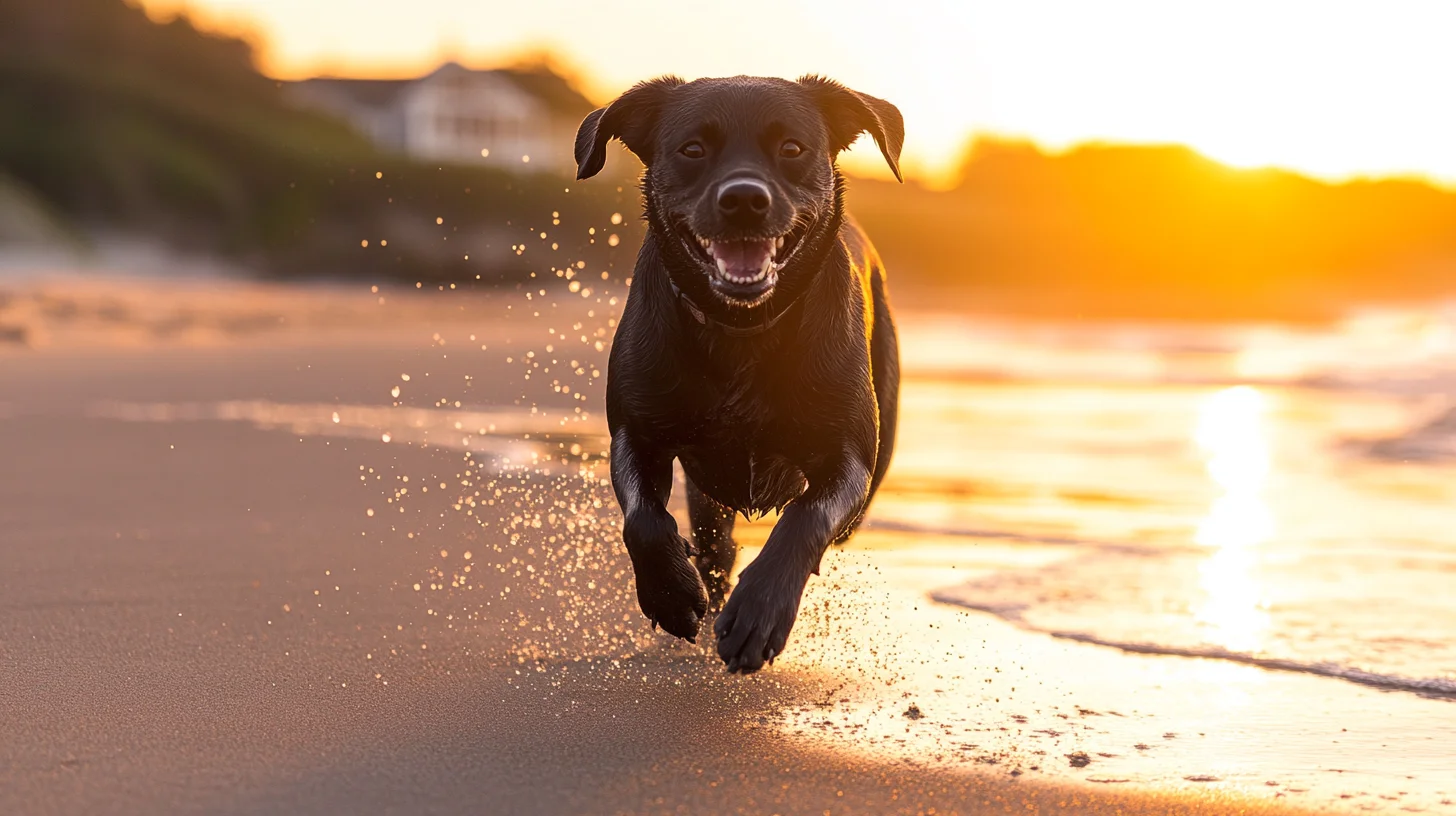
Every dog I photograph on the South Shore is on a leash during the session. Every single one. Not just the reactive ones — the goldens, the labs, the well-trained adult dogs with perfect recall, all of them. The leash is removed digitally in editing, and the final portraits look exactly the way you imagine when you picture a dog running free on a beach. This is not a reactive-dog compromise. It's my standard practice, and it's the right answer for practical, ethical, and image-quality reasons. Here's the full explanation.
Why the Leash Stays On — Every Dog, Every Session
The single most important reason is safety. An off-leash dog at a public location is one unpredictable event away from a serious outcome. A loose dog running onto a road, a wildlife encounter at a conservation area, a reactive dog appearing around a corner at a park — none of these are hypothetical. I've photographed on the South Shore for over a decade and watched all three happen at locations I use regularly.
The second reason is legal. Most Massachusetts municipalities have leash laws that apply at beaches, conservation land, and state parks — often year-round, sometimes seasonally. A ranger citation ends a session and costs the client money. An off-leash dog bite incident can cost much more than that. I don't take that risk with a client's dog.
The third reason, and the one that surprises most owners: photographed dogs behave differently on and off leash. An off-leash dog expands their movement radius dramatically, which means I spend the session chasing them to maintain composition instead of making photographs. On leash, their movement is bounded — they can still play, run, sniff, and be themselves, but within a predictable radius that I can compose around. The portraits are better.
How Leash Removal Actually Works
Modern post-processing tools handle leash removal cleanly when the photographer shoots with removal in mind. The technique isn't magic — it's a combination of small in-camera choices and careful editing. I use a thin biothane or paracord leash (not a thick leather show leash — those are much harder to remove cleanly) and I frame compositions so the leash runs against clean, predictable backgrounds whenever possible.
In editing, the leash is removed using a combination of clone, heal, and generative fill tools against the surrounding background. Grass, sand, sky, wood flooring, and out-of-focus foliage all remove cleanly. The hard cases are when the leash crosses over the dog's own body — especially a complex coat like a merle Aussie or a tri-color Bernedoodle. I shoot those compositions from angles that keep the leash off the dog when I can, and I handle the overlapping portions manually when I can't.
The entire removal process adds roughly ten to thirty seconds per image to the editing workflow. Across a gallery of forty portraits, it's about twenty minutes of additional work. Clients never see it. They see a clean, natural-looking portrait of their dog.
What a Good Leash Looks Like for a Session
For the easiest removal in post-processing, thin beats thick and solid color beats patterned. A plain biothane leash in black, brown, or olive is my default recommendation — they're about 3/8 inch wide and photograph as a clean line rather than a textured band. Paracord is also excellent. Chain leashes, heavily branded training leashes, and thick rope leads are harder to remove — not impossible, just more work.
If your dog uses a specific training tool — a prong collar, a front-clip harness, a head halter — it stays on through the session and comes out of the final images. Safety during the session comes first. I'll work around whatever your dog uses to stay settled.
The One Time I Don't Remove the Leash
When the client asks me to keep it. Some owners specifically want a handful of portraits with the leash visible — working dog handlers, dogs who are part of a harness or mobility story, people photographing a dog alongside a child who's holding the lead. In those cases we shoot both versions and deliver both. The leash removal is a default, not a requirement.
What About Studio Sessions?
The Rockland studio is a fully enclosed space, so the safety calculus is different. Dogs are still on leash in the studio unless they've clearly demonstrated comfort and the owner is present and managing. But studio leashes are much easier to remove — the clean backdrop means no complex background to rebuild. Most studio portraits go from leashed-original to leash-free-final in under ten seconds per image.
Key Learning
“A photographer who refuses to use leashes because it's ‘too much editing’ is telling you they'll accept unnecessary risk with your dog to save themselves fifteen minutes. Leash-on photography with skilled post-processing is the correct answer. There is no trade-off between safety and final image quality — if anyone suggests there is, they're either inexperienced or cutting the wrong corner.”
Book a Session — Your Dog Stays Safe
Every session I photograph is conducted with the leash on and removed cleanly in editing. Reactive or not, high-energy or calm, your dog stays tethered and you get portraits that look completely free.
Keep Reading
SESSION STRUCTURE
A Reactive Dog Photo Session, Minute by Minute
The full walkthrough of how a session is structured for reactive and anxious dogs — where leash-on fits in...
PREPARATION
How to Prepare Your Dog for a Professional Photoshoot
Six things you can do in the days before the session to help your dog show up at their best...
REACTIVE DOGS
Reactive Dog Photography: What Every Owner Needs to Know
The broader framework for reactive dog sessions — environment control, in-home options, and working with what your dog gives us...
MUZZLES
Muzzle-Safe Photo Sessions
How muzzled dogs are photographed — with the same editorial care as leash removal, and without the stigma...
“It was so fun and easy to work with Chris, and our dogs loved him, too! The photos and artwork are beautiful! Highly recommend booking a session.”

About the Author
Chris McCarthyProfessional Dog Photographer · Rockland, MA · 11+ years experience
I've photographed hundreds of dogs across the South Shore and Boston since 2014 — every breed, size, age, and temperament. My own rescue, Sully, was reactive and anxious when I got him, and working with him every day taught me how to photograph dogs that other photographers find difficult. I specialize in reactive and shy dogs, seniors, and memory sessions — the sessions that matter most and need the most patience.