Husky Tails, Snow Nose, and Other Siberian Husky Quirks Explained
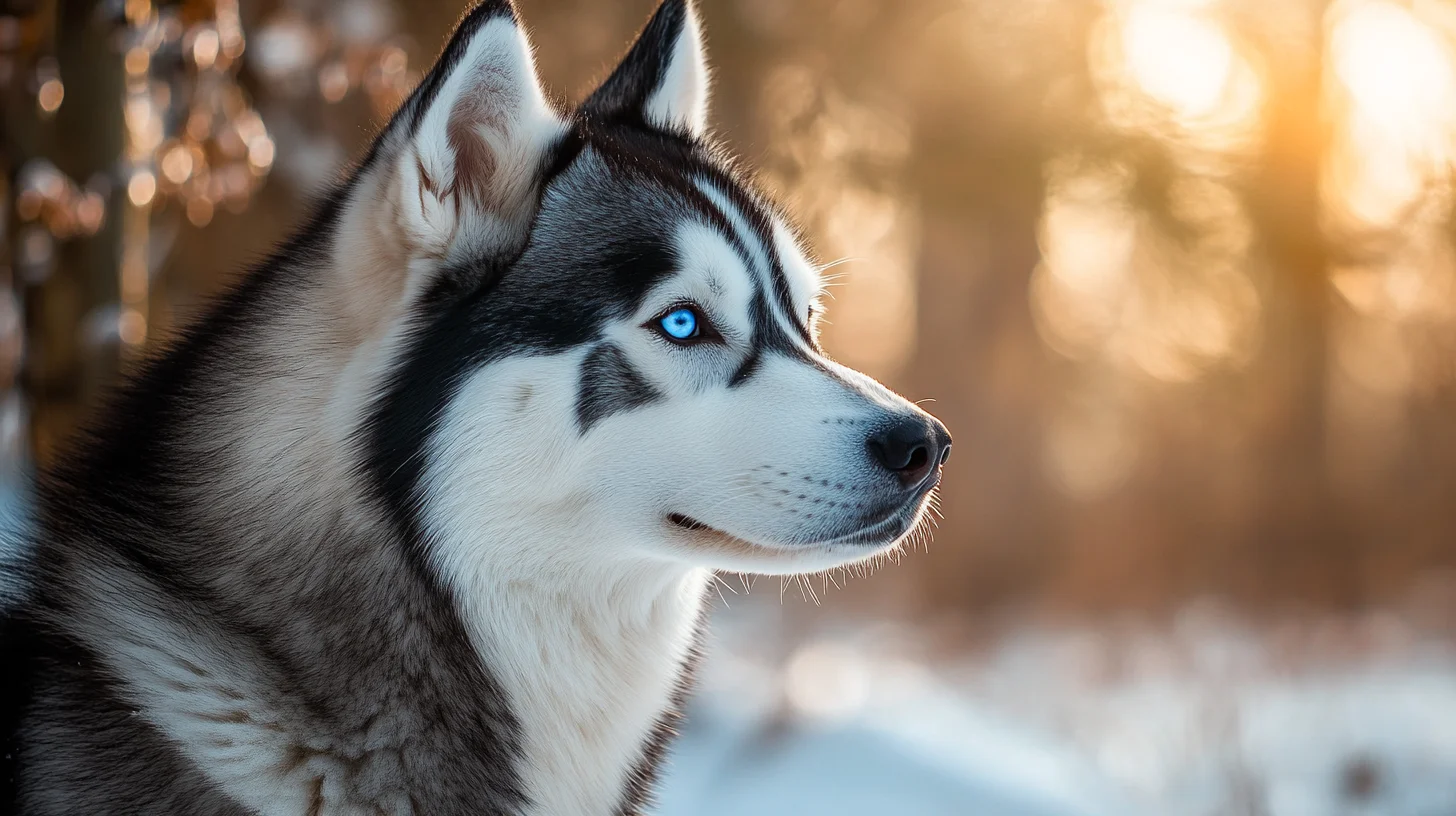
Siberian Huskies have more visually distinctive traits per dog than almost any other breed. The curled tail. The two-tone or fully blue eyes. The mask. The snow nose. The double coat that sheds in clouds twice a year. The talking. After photographing many huskies on the South Shore, I get more questions about why huskies look and behave the way they do than about any other breed — usually from owners who are mid-puzzle about something their dog just did.
What follows is a practical, photographer's-eye guide to the quirks that make Siberian Huskies what they are. None of this is veterinary advice — for medical questions, always consult your vet — but it should answer most of the “is my husky normal?” questions that come up in the first year of ownership.
Why Do Huskies Have Curly Tails?
The curled or sickle-shaped tail is one of the breed's defining traits, and there's a real evolutionary reason for it: sled dogs were bred to work in arctic conditions, and a curled tail tucks neatly over the dog's face when curled up to sleep, filtering the air they breathe and conserving heat. The same trait shows up in other arctic breeds — Akitas, Malamutes, Samoyeds, Shibas — all selected from the same ancient working population.
The tail's position is also a fluent body-language signal. A husky's tail held high in a tight curl signals confidence or alertness. A relaxed husky's tail rests in a loose sickle shape over the hips. A husky carrying their tail straight down is signaling discomfort, fear, or submission — and a tucked tail (between the legs) is the same alarm signal it is in any other breed. Reading the tail is the fastest way to read a husky's mood.
Not every husky has the picture-perfect tight curl. Some have looser, longer curves; some have nearly-straight tails. None of this is wrong — it's breed variation. If your husky's tail changes shape suddenly (especially going limp), that warrants a vet visit. “Limber tail” — temporary paralysis from overexertion, cold water, or muscle strain — is a known condition in working breeds and usually resolves on its own with rest.
What Is “Snow Nose” and Why Does It Happen?
Snow nose — also called “winter nose” or hypopigmentation — is the seasonal lightening of a dog's normally black nose to brown, pink, or a mottled mix. It's extremely common in huskies, Labradors, Goldens, and Bernese Mountain Dogs. In most cases the nose darkens again in summer and lightens again in winter, year after year.
The cause is poorly understood but appears to involve the breakdown of the enzyme tyrosinase, which is needed to produce the pigment melanin. Tyrosinase is temperature-sensitive — it works less efficiently in cold weather — and that's the leading theory for why snow nose is seasonal. It's purely cosmetic. Snow nose is not painful, not a sign of illness, and doesn't require treatment.
That said, a few nose conditions do need attention: cracked or crusty texture (not just color change), bleeding, swelling, or a change in shape. Those warrant a vet visit. A nose that simply turns brown in winter and black again by mid-summer is just snow nose and is genuinely nothing to worry about.
Heterochromia — Why Some Huskies Have Two Different Colored Eyes
Roughly 15% of Siberian Huskies have heterochromia — eyes of two different colors. Most often this is one brown eye and one blue eye, though “parti-eyes” (where a single eye contains two colors) also occur. The trait is genetic and is unique to the husky lineage at this frequency among common breeds.
Heterochromia in huskies is not associated with any health problems. It's purely a pigment quirk. Husky vision is identical between the two eyes. This is one trait where photographers get genuinely excited — heterochromia is one of the most distinctive things you can capture in a portrait, and it shows best when lit from slightly above with even, soft light so both eye colors hold their saturation.
The Double Coat — Why Huskies Shed in Clouds
The husky double coat consists of two distinct layers: a soft, dense undercoat for insulation, and a longer, coarser guard coat for protection. Twice a year — usually spring and fall — the undercoat “blows” in massive quantities. Owners new to the breed are usually unprepared for the volume. Daily brushing during these weeks is non-negotiable.
Critically: never shave a husky double coat. The double coat regulates temperature in both directions — it insulates in winter and protects from sun and heat in summer. Shaving exposes the dog to sunburn, removes the dog's primary cooling system, and frequently the coat grows back patchy or with altered texture. Regular brushing keeps a husky comfortable in any weather; shaving is actively harmful.
For photography, the double coat is a gift. Backlit at golden hour, husky guard hairs glow like wire. The texture catches light in ways no smooth-coated breed can match. The outdoor sessions on the South Shore we run for huskies almost always favor late afternoon for exactly this reason.
Why Huskies “Talk” — The Vocalizations
Huskies are one of the most vocal breeds in existence. They howl, woo-woo, grumble, scream, sigh dramatically, and produce sounds that often resemble (and occasionally are interpreted as) human speech. The reason is partly genetic — huskies are closely related to wolves and retain wolf-like vocal patterns — and partly social. Huskies were bred to work in large teams and to communicate constantly. The instinct to talk is hard-wired.
What this means in practice: huskies will tell you when they're displeased, when they want food, when you've been gone too long, and when you've made a decision they disagree with. The famous “husky tantrum” videos are not abnormal behavior — they're core breed expression. A quiet husky is rare; a vocal husky is the breed working as designed.
The Mask, the Mantle, and Coat Color Variation
Huskies come in a wider range of coat patterns than most breeds: black and white, gray and white, red and white, agouti (banded hairs), sable, all-white, and rare patterns like piebald. The facial “mask” — the distinct markings around the eyes and over the muzzle — is one of the most recognizable features and varies dog to dog. Some have full masks, some have open faces (no mask), some have only partial masks.
Coat color and mask pattern have no functional purpose — they're just genetic variation. Photographically, the mask is critical: a dark mask helps frame the eyes and is one of the strongest visual hooks in a husky portrait. Open-faced huskies require different lighting strategy to make the eyes pop. The Husky photographer guide covers breed-specific lighting in more detail.
Why Huskies Are So Hard to Recall — The Independent Streak
Siberian Huskies have a well-deserved reputation for poor recall in open environments. The reason is functional: huskies were bred to make independent decisions in the field. Sled dogs that wait for instructions before navigating broken ice are slow sled dogs. Huskies that decide for themselves are fast ones. Centuries of breeding for independence produced a dog that is highly trainable but selectively obedient.
For owners this means most huskies should be on-leash or long-line in non-fenced environments throughout their lives — not because they're untrainable, but because the recall trade-off rarely lands in the owner's favor when prey is around. For photography sessions, this is the most common factor in choosing location: enclosed fields, fenced trails, or beaches with wide sightlines where a long-leash session works without compromising safety. The leash is always removed in editing — you'll never see it in the final portraits.
Are Siberian Huskies Hard to Train?
Huskies are not hard to train. They're hard to motivate. Most working breeds are eager to please — they read training as a partnership. Huskies read training as a negotiation. They'll learn a behavior in five repetitions, then decide whether to perform it based on the situation, the reward on offer, and whether anything more interesting is happening nearby. A husky who knows “come” in the kitchen will absolutely not come when there's a squirrel in the yard.
What works: high-value rewards (real meat or cheese, not kibble), short training sessions, varied contexts, and acceptance that you're building cooperation rather than obedience. What doesn't work: punishment-based training (huskies shut down or become more independent), repetition drilling (they get bored and check out), and assuming on-leash compliance translates to off-leash compliance (it doesn't — almost ever).
For owners considering the breed, this is the single most important thing to understand. A husky in the wrong home — under-exercised, under-stimulated, expected to behave like a Lab — is a destructive husky. A husky in the right home, with enough exercise and mental engagement, is one of the most rewarding breeds you can own.
Photography Considerations for Huskies on the South Shore
Bringing it all together: a great husky portrait usually combines a few specific decisions. Late afternoon or golden hour light to catch the double coat. A location with wide sightlines for reactive or high-prey-drive dogs. Exposure dialed in carefully — blue eyes can blow out under direct sun, and white coat sections behave very differently from black coat sections in the same frame. The right session day is usually cool and overcast or cool and golden — huskies overheat easily.
South Shore locations that work especially well for husky sessions: Wompatuck State Park (Hingham) for shade and wide trails, Duxbury Beach off-season for cool wind and open frame, the Norris Reservation salt marsh boardwalk for atmospheric backlit work. For more options, the South Shore location index covers every town we shoot in. For broader portrait guidance, the dog portrait photography pillar walks through studio vs outdoor, breeds, and pricing.
The Short Version
- Curly tail: evolved for arctic sleep position; also a body-language signal.
- Snow nose: seasonal pigment loss tied to enzyme activity in cold weather. Cosmetic only.
- Heterochromia: roughly 15% of huskies have mismatched eyes. No health implications.
- Double coat: regulates temperature both ways. Never shave.
- Talking: wolf-derived vocal pattern, hard-wired social communication.
- Masks & colors: wide variation, no functional purpose, photographically essential.
- Poor recall: bred for independence. Long-line or fenced environments only.
Husky Portrait Sessions on the South Shore
Breed-specific sessions for Siberian Huskies — coat-aware lighting, wide-sightline locations, and recall-safe planning. Sessions from $395.
Related guide: Winter Dog Photography on the South Shore — cold-weather session technique — snow coat work and winter location picks.

About the Author
Chris McCarthyProfessional Dog Photographer · Rockland, MA · 11+ years experience
I've photographed hundreds of dogs across the South Shore and Greater Boston since 2014 — every breed, size, age, and temperament. My own rescue, Sully, was reactive and anxious when I got him, and working with him every day taught me how to photograph dogs that other photographers find difficult. I specialize in reactive and shy dogs, seniors, and memory sessions — the sessions that matter most and need the most patience.